
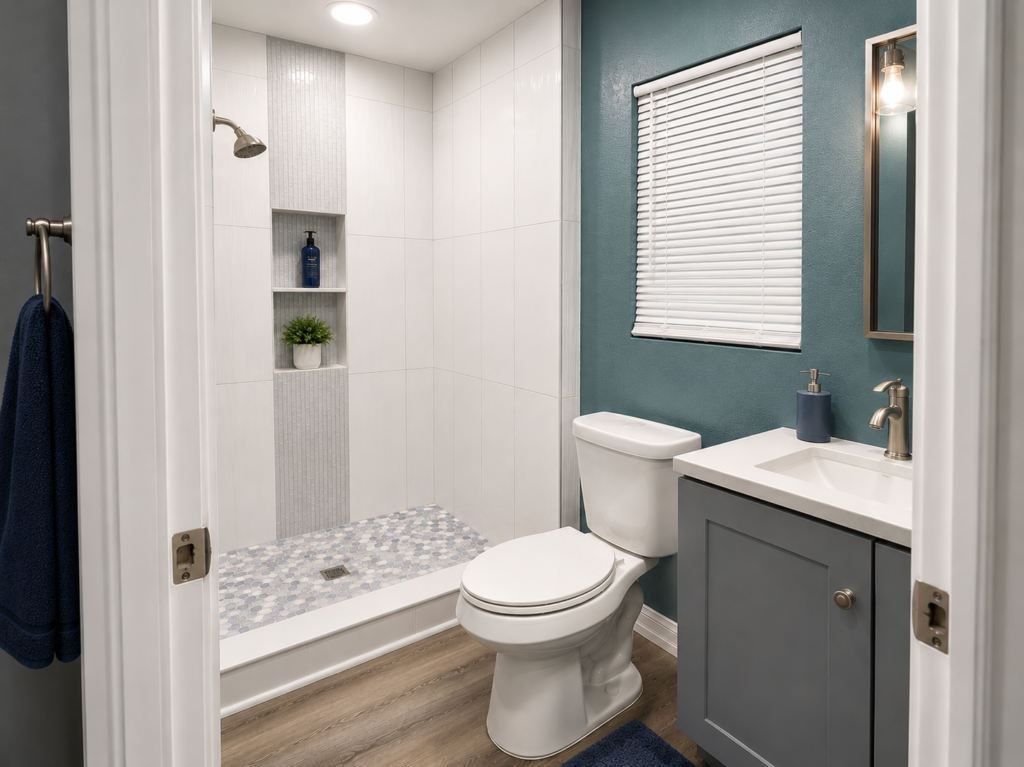
Most bathroom renovation in Florida require a permit. The line sits between cosmetic work and anything that touches plumbing, electrical, or structure. Paint the walls, no permit. Move a drain, swap a toilet, or add an exhaust fan with new wiring? Permit required.
There is a new law in play. Florida HB 803, signed May 6, 2026, and effective July 1, 2026, exempts single-family home projects valued under $7,500 from permits. But the exemption explicitly excludes all plumbing, electrical, structural, mechanical, and gas work. For most real bathroom renovations, nothing changed.
Here is what actually triggers a permit in Pinellas County, which building department you file with, and what happens if you skip it.
Key Takeaways
- Plumbing, electrical, structural, and HVAC work always requires a permit in Florida, regardless of cost
- Florida HB 803 (July 1, 2026) exempts sub-$7,500 cosmetic work, but excludes all trades. Most remodels still need a permit
- In Clearwater and most Pinellas cities, you file with your city building department, not the county
- Unpermitted bathroom work can void homeowner’s insurance, trigger fines up to $5,000 per violation, and must be disclosed to buyers under Florida law
- Flood zone homeowners face additional requirements that can change the entire scope of the project
Table of Contents
- What triggers a permit for a bathroom remodel in Florida?
- Which building department do you file with in Pinellas County?
- What does Florida’s new $7,500 permit exemption actually cover?
- What happens if you skip a required permit?
- Flood zones and the Pinellas catch
- What does the permit process look like from start to finish?
-
Frequently Asked Questions
- Does a simple bathroom refresh need a permit in Clearwater?
- How long does a bathroom permit take in Pinellas County?
- Can I pull my own permit as a homeowner in Florida?
- What happens if my bathroom remodel was done without a permit in Florida?
- Does a bathroom remodel in a flood zone require anything extra?
What triggers a permit for a bathroom renovation in Florida?
The short answer: anything behind the walls.
Cosmetic updates are generally exempt. Paint, new tile over existing tile, a vanity swap in the same location, and flooring replacement in most cases do not require a permit. The moment work touches a licensed trade or moves something from its current location, you need one.
| Work Type | Permit Required? |
| Painting, wallpaper, cosmetic tile | No |
| Vanity or toilet replacement in same location | Generally no |
| Moving a toilet, sink, or drain | Yes — plumbing permit |
| Adding or relocating outlets | Yes — electrical permit |
| Exhaust fan with new wiring | Yes — electrical permit |
| Walk-in shower conversion (new drain, waterproofing) | Yes — plumbing permit |
| Expanding the bathroom renovation (removing a wall) | Yes — building + structural |
| Steam shower or heated flooring | Yes — electrical or mechanical |
| HVAC relocation or new duct | Yes — mechanical permit |
| Window addition or enlargement | Yes — building permit |
The Florida Building Code does not give bathrooms a pass because they are small. Coastal Pinellas County applies stricter-than-average scrutiny to moisture management and ventilation after the 2024 storms. Inspectors check waterproofing behind shower assemblies, GFCI protection at every outlet within six feet of water, and exhaust fan capacity against the room’s cubic footage.
One project type surprises people regularly. Replacing an exhaust fan in the same location using existing wiring typically does not require a permit. Routing new wiring for that same fan does. That single distinction catches a lot of DIY projects mid-construction.
If you want to understand what a fully permitted renovation covers from start to finish, the Clearwater bathroom renovations page breaks down what each scope of work involves and what to expect at every stage.
Which building department do you file with in Pinellas County?
Most homeowners assume the answer is Pinellas County. For most of Pinellas, that is wrong.
Pinellas County Building and Development Review Services (BDRS) handles permits for unincorporated areas and six partner communities: Belleair Beach, Belleair Shore, Indian Rocks Beach, Kenneth City, Safety Harbor, and Oldsmar. Everyone else files with their own city.
| If your home is in | File with |
| Unincorporated Pinellas (includes most of Palm Harbor) | Pinellas County BDRS, 440 Court St, Clearwater |
| Belleair Beach, Belleair Shore, Indian Rocks Beach | Pinellas County BDRS |
| Kenneth City, Safety Harbor, Oldsmar | Pinellas County BDRS |
| City of Clearwater | City of Clearwater Construction Services, ePermitting portal |
| St. Petersburg, Dunedin, Largo, Tarpon Springs | That city’s own building department |
Not sure which applies to your address? Use the Pinellas County Property Appraiser at pcpao.gov or the county’s My Neighborhood tool. Getting this wrong matters: permits filed with the wrong jurisdiction are non-refundable, and the fee goes with them.
For the City of Clearwater, applications go through the ePermitting system at myclearwater.com. For construction valued over $5,000, a Notice of Commencement must be recorded with Pinellas County before the first inspection can be scheduled. That applies whether you file with the county or the city.
Plan review takes 10 to 30 business days under Florida Statute HB 267. Resubmittals after corrections add 5 to 15 more days. If you are also weighing a kitchen renovation at the same address, the Florida kitchen remodel permit guide walks through how the two permit processes interact when you run them at the same time.
What does Florida’s new $7,500 permit exemption actually cover?
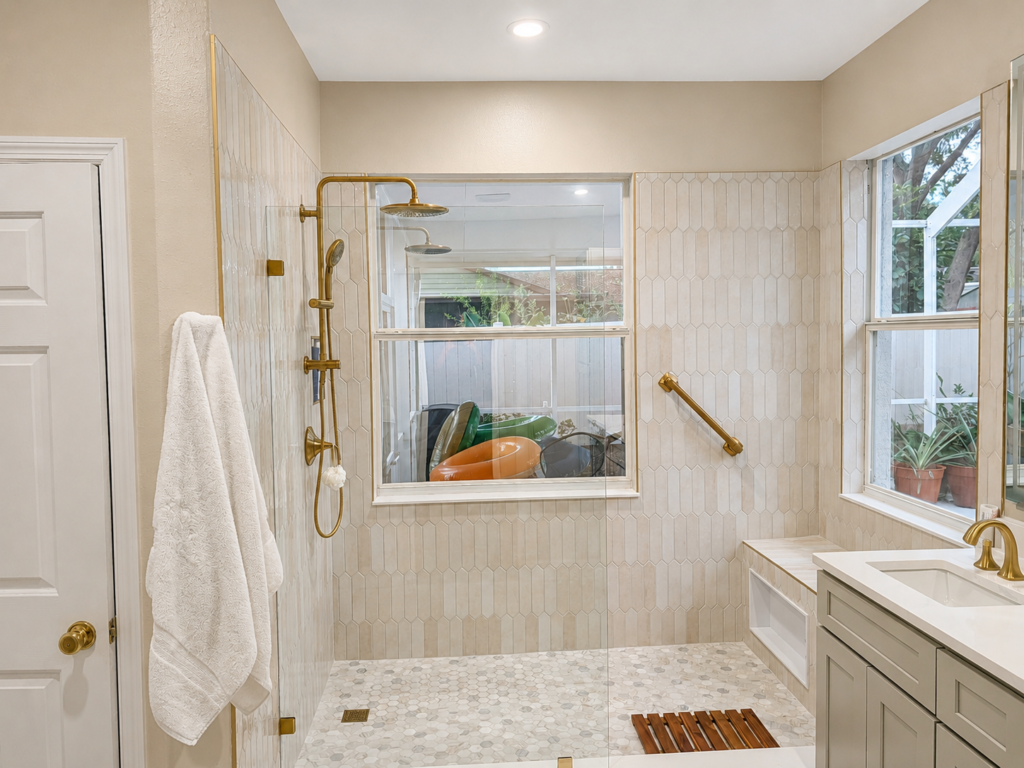
Florida HB 803, signed May 6, 2026 and effective July 1, 2026, exempts single-family residential work valued under $7,500 from building permits. It generated a lot of headlines. For bathroom renovation, it changes very little.
The law explicitly excludes these five trades from the exemption, regardless of project cost:
- Electrical work
- Plumbing work
- Structural work
- Mechanical work (HVAC)
- Gas work
Those trades cover virtually every task in a real bathroom renovation. The exemption is genuinely useful for homeowners painting a room, replacing flooring, or refreshing cabinets. It does not help anyone moving a drain, running new wiring for a vanity light, or converting a tub to a walk-in shower.
Three more limits that matter in Pinellas County. First, the exemption does not apply to properties in designated flood hazard areas, and a large portion of coastal Pinellas falls inside FEMA-designated Special Flood Hazard Areas. Second, the law bans splitting a larger project into smaller invoices to get under the threshold. A $20,000 bathroom renovation broken into three invoices is still treated as a $20,000 project. Third, work done under the exemption must still meet the Florida Building Code in full. The permit is waived, not the code.
For context on what a typical permitted bathroom renovation costs in Clearwater so you can plan your budget before the permit application, see the bathroom makeover cost breakdown with real Pinellas ranges.
What happens if you skip a required permit?
The risks are real and they compound.
Insurance. If unpermitted work causes damage, a leak from a drain relocated without a permit for example, your homeowner’s insurer can deny the claim. The unpermitted work becomes a known defect that voids coverage for the resulting damage.
Fines. Florida law allows penalties from double the original permit fee up to $5,000 per violation, with some jurisdictions adding daily accruing fines until the violation is corrected. On a $20,000 bathroom renovation, the permit typically costs $350 to $600. Getting caught without one can cost $700 to $2,000 or more, before any corrective work begins.
Disclosure at resale. Florida law requires sellers to disclose known material defects. Unpermitted work you are aware of qualifies. An as-is contract does not remove that duty. Buyers who find hidden unpermitted remodels can demand repairs, reduce their offer, or walk away entirely.
After-the-fact permits. If unpermitted work surfaces during a sale or refinance, an after-the-fact permit requires inspection, possible wall openings to expose the rough work, and full current-code compliance at your cost.
Skipping a required permit is the one bathroom renovation mistake with the longest tail. It does not surface for months or years, and it always costs more to fix than the permit would have.
A licensed contractor pulls the permit as part of the job, files it in your name, and manages every inspection stage. That record protects you at resale and keeps your insurance valid throughout.

Flood zones and the Pinellas catch
Standard bathroom permit rules apply to most Clearwater and Pinellas homes. If your property sits in a FEMA-designated Special Flood Hazard Area, the picture is different.
In flood zone properties, the $7,500 HB 803 exemption does not apply at all. Beyond that, FEMA’s 50% Rule triggers a substantial improvement review when cumulative improvements at a flood zone address reach 49% of the home’s assessed value. A bathroom renovation alone rarely hits that number. But stacking a bathroom renovation on top of a kitchen remodel, a room addition, and storm damage repairs at the same address can push a property over the threshold. When that happens, the entire structure must be brought into current flood zone compliance, which can mean elevating the home’s lowest floor.
Check your flood zone status at FEMA’s Flood Map Service Center at msc.fema.gov before committing to any scope at a coastal Pinellas address. If your property is in Zone AE or VE, confirm your cumulative improvement history with the building department before submitting the permit application.
For out-of-state owners managing a remodel remotely, flood zone interactions are exactly where things go sideways without local oversight. The Florida remote home renovation service covers how permit coordination and inspection management works for homeowners who are not on the ground in Pinellas.
What does the permit process look like from start to finish?
A typical permitted bathroom renovation in Pinellas County runs in this order:
| Stage | What happens | Who |
| 1. Scope confirmation | Identify all trades; confirm city vs. county jurisdiction | Contractor or homeowner |
| 2. Permit application | Drawings, trade permit requests, project value submitted | Licensed contractor |
| 3. NOC recording | Required over $5,000; must be on site at every inspection | Homeowner records |
| 4. Plan review | 10 to 30 business days; corrections add 5 to 15 more | Building department |
| 5. Rough inspections | Plumbing rough-in, electrical rough-in, framing if walls opened | Inspector |
| 6. Waterproofing and insulation | Required before drywall or tile | Inspector |
| 7. Drywall and tile | Work continues after rough inspections pass | Contractor |
| 8. Final inspection | All trades signed off; final building sign-off | Inspector |
Each stage must clear before the next begins. Closing up a wall before rough plumbing passes means opening it back up.
Before you hire anyone, check their license in the Pinellas County Construction Licensing Board database and confirm it is active. Permits are not processed for contractors with expired or inactive licenses, and that problem lands on you mid-project. Our guide on what to look for in a general contractor covers every other box to check before signing.
One Clearwater Construction files the permit application, records the Notice of Commencement, manages all inspections, and handles any resubmittals if plan review comes back with questions. You get one point of contact from application to final sign-off.
Call (727) 314-2191 or request a free estimate. We remodel bathrooms throughout Clearwater, St. Petersburg, Dunedin, Palm Harbor, Safety Harbor, Largo, Tarpon Springs, and Oldsmar.
Frequently Asked Questions
Does a simple bathroom renovation refresh need a permit in Clearwater?
If the work is purely cosmetic, paint, new tile over existing tile, a vanity swap in the same location with no plumbing relocation, and the total project value is under $7,500, it may qualify for the HB 803 exemption effective July 1, 2026. You still need to submit a written exemption request to the building department, and the work must meet the Florida Building Code. Any work touching plumbing, electrical, or structure still requires a permit regardless of cost.
How long does a bathroom renovation permit take in Pinellas County?
Plan review takes 10 to 30 business days from a complete application under Florida Statute HB 267. If the reviewer requests corrections, resubmittals add another 5 to 15 days. After the permit issues, individual inspections typically schedule within one to two business days. Total timeline from permit submission to final inspection on a standard bathroom renovation runs eight to twelve weeks. Starting during the off-season, November through April, tends to reduce scheduling delays in a county processing elevated post-storm permit volumes.
Can I pull my own permit as a homeowner in Florida?
Yes, under Florida Statute 489.103(7). The property must be in your name and used as your primary residence. You take on full responsibility for code compliance, inspection scheduling, and the quality of all work. You also cannot sell or rent the property for one year from completion. For licensed trade work including electrical, plumbing, and HVAC, those subcontractors must still be licensed and listed on the permit. Most homeowners find that the liability and coordination involved make a licensed contractor the safer path, especially when combining a bathroom renovation with a larger home renovation project.
What happens if my bathroom renovation was done without a permit in Florida?
Florida disclosure law requires you to tell buyers about known material defects, and unpermitted work qualifies. Your homeowner’s insurance may deny claims for damage caused by that unpermitted work. After-the-fact permits require inspections, possible wall openings to expose rough work, and full compliance with current code at your cost. Fines can reach $5,000 per violation. Resolving it before listing is always cheaper than resolving it after a buyer discovers it during their inspection.
Does a bathroom renovation in a flood zone require anything extra?
Yes, significantly. The $7,500 HB 803 exemption does not apply in designated flood hazard areas. Flood zone properties are also subject to FEMA’s 50% Rule: cumulative improvements reaching 49% of the home’s assessed value trigger full flood compliance for the entire structure, which can mean elevating the lowest floor. Check your status at msc.fema.gov before committing to a scope. Homes that have already had post-hurricane repairs and renovations need to factor that work into the cumulative total before adding another permitted project.