
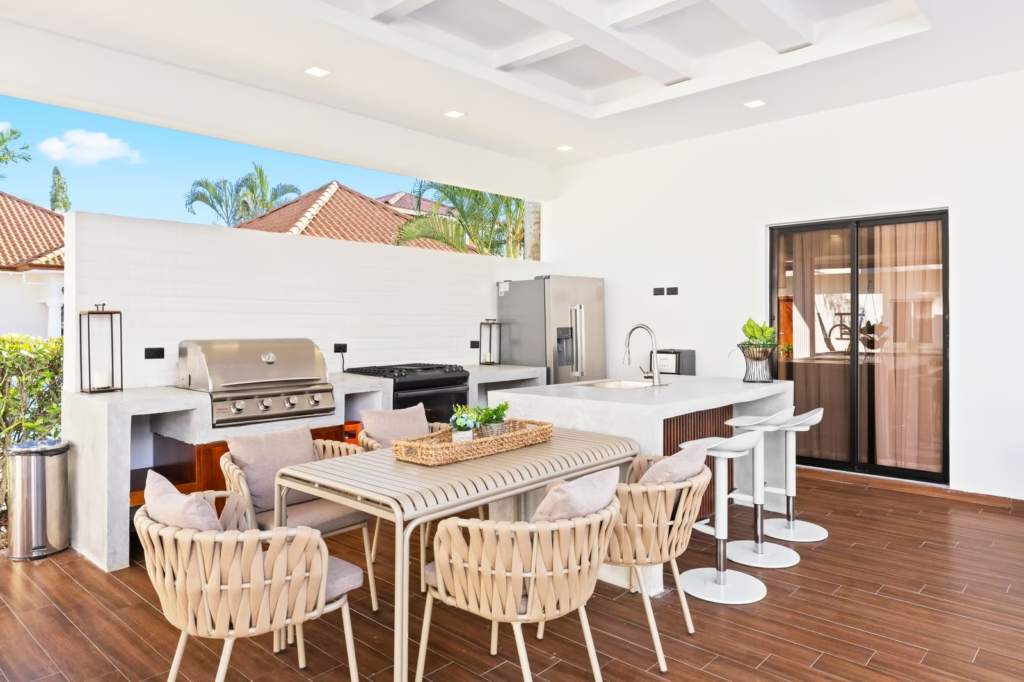
A built-in outdoor kitchen island in Clearwater runs $3,000 to $10,000 installed, and a full outdoor kitchen runs $7,000 to $35,000, per 2026 data from HomeGuide. In Pinellas County the grill is not the variable. Permitting, wind code and salt air are.
Most guides on this topic were written for Ohio. They tell you to frame the island in pressure-treated lumber, tile it, and enjoy.
That skips the three things that decide whether an outdoor kitchen island here lasts fifteen years or fifteen months: a 150 mph design wind speed, chloride-heavy Gulf air, and a permit office that is probably not the one you assumed.
Key Takeaways
- Built-in grill island: $3,000 to $10,000 installed. Full outdoor kitchen: $7,000 to $35,000.
- Pinellas County permits only six named areas. Clearwater, St. Petersburg, Dunedin, Largo and Tarpon Springs homeowners file with their own city.
- Pinellas enforces a 150 to 160 mph ultimate design wind speed, the strictest in Florida outside Miami-Dade.
- Within a mile of the Gulf or Intracoastal, specify 316 marine-grade stainless. Salt air pits 304.
- Projects over $5,000 need a recorded Notice of Commencement on site at every inspection.
- Gas, plumbing, new electrical or a roof triggers a permit. A freestanding island on an existing slab usually does not.
Table of Contents
- How much does an outdoor kitchen island cost in Clearwater?
- Do you need a permit for an outdoor kitchen island in Pinellas County?
- Which building department do you file with?
- Three requirements that surprise people
- Which materials survive Clearwater's salt air?
- How should it be built for Pinellas wind and flood zones?
- Flood zones and the substantial improvement rule
- Should you DIY or hire a licensed contractor?
- How do you protect an outdoor kitchen island during hurricane season?
- What a compliant Clearwater build looks like
- Ready to price your outdoor kitchen island?
- Frequently Asked Questions
How much does an outdoor kitchen island cost in Clearwater?
Expect $3,000 to $10,000 installed for a built-in grill island. HomeAdvisor puts the national outdoor kitchen range at $6,348 to $26,903, averaging $16,480, or $33 to $130 per square foot.
Those figures cover structure and labor. Not appliances, and not the permit path.
| Tier | What you get | Installed cost |
| Prefab drop-in island | Factory unit, 4 to 6 ft, existing slab and utilities | $1,500 to $6,000 (unit alone) |
| Built-in grill island | Masonry or steel frame, built-in grill, 1 to 2 cabinets, existing hookups | $3,000 to $10,000 |
| Full custom outdoor kitchen | L or U shape, grill plus fridge and sink, new utility runs, stone or porcelain counters | $10,000 to $35,000 |
What moves the number
The shell is the cheap part. Appliances and trades drive the total:
- Built-in gas grill: $1,500 to $5,000 mid-range, $5,000 to $10,000 and up premium
- Outdoor-rated refrigerator: $800 to $2,500
- Sink: $300 to $800 plus plumbing
- Countertop: $750 to $4,000 for a typical 10 to 12 foot island
- Plumber: $45 to $150 per hour; a new water line runs $450 to $1,800 per fixture
- Electrical: $4 to $9 per square foot, plus $180 to $350 per new outdoor outlet
An island a few steps from the house shares existing gas, water and power. Push it to the back of the yard and you pay to trench all three. That siting decision matters as much to your budget as the rest of your outdoor living space layout.
Pinellas costs national calculators ignore
Budget $500 to $2,000 on top for compliance. That covers professional drawings ($200 to $1,000), plan revisions if the reviewer asks for changes ($100 to $500), Notice of Commencement recording, and a boundary survey issued within the last five years.
Skipping this line is the most common reason a project stalls.
Do you need a permit for an outdoor kitchen island in Pinellas County?
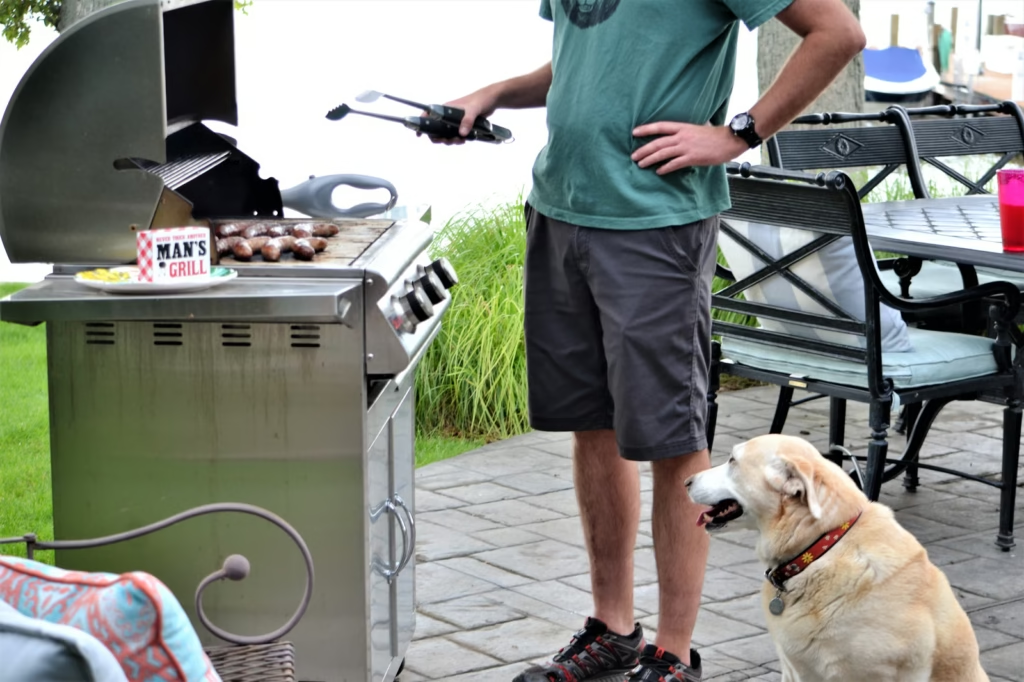
Usually yes. Connect to gas, water or new electrical, or put a roof over it, and a permit is required. A freestanding island on an existing slab with a portable propane tank and an existing outlet generally is not.
But answer a harder question first.
Which building department do you file with?
Most homeowners assume the county handles it. For most of Pinellas, that is wrong. The Pinellas County permitting guide states it serves unincorporated areas, Belleair Beach, Belleair Shore, Indian Rocks Beach, Kenneth City, Safety Harbor and Oldsmar. Everyone else files with their own city.
| If your home is in | You file with |
| Unincorporated Pinellas (including most of Palm Harbor) | Pinellas County BDRS |
| Belleair Beach, Belleair Shore, Indian Rocks Beach | Pinellas County BDRS |
| Kenneth City, Safety Harbor, Oldsmar | Pinellas County BDRS |
| City of Clearwater | City of Clearwater Building Division |
| St. Petersburg, Dunedin, Largo, Tarpon Springs | That city's own building department |
Confirm your jurisdiction through the county's My Neighborhood tool or the Property Appraiser at pcpao.gov. Some cities also require a preapproval letter uploaded with the county submittal.
Get this wrong and it costs you. Permits applied for in error are non-refundable.
Pinellas County BDRS is at 440 Court Street, Clearwater, open Monday to Friday 8 a.m. to 4 p.m., (727) 464-3888. Inspections: (727) 453-4000, 3:30 p.m. cutoff for next-day.
What triggers a permit
- Hard gas line. Requires a licensed gas fitter and inspection before use.
- New electrical. Florida code is strict on GFCI and moisture-rated wiring; inspection verifies burial depth and grounding.
- Plumbing. A sink means supply and drainage inspections. A dry bar is simpler than a wet one.
- Roof, pergola or cover. Now a structure, engineered for wind load.
- Permanent footings or masonry. Treated differently from a unit sitting on a slab.
The same trigger logic applies indoors, which is why we broke down kitchen remodel permits in Florida separately.
Three requirements that surprise people
- Notice of Commencement. Required over $5,000 in building trade value, and per Florida statute it must be on site for every inspection.
- Current survey. Must be issued within the last five years. Outdated surveys are rejected.
- Owner-builder rules. You must appear in person with a valid state ID for affidavit verification.
A licensed builder handling your outdoor kitchen project in Pinellas County files the application, records the NOC, lists subcontractors and books every inspection as part of the job.
Which materials survive Clearwater's salt air?
Near the water, grade matters more than design. Chloride attacks metal continuously, not just during storms.
304 versus 316 marine grade
One element separates them: molybdenum.
| Grade 304 | Grade 316 (marine) | |
| Chromium | 18% | 16% |
| Nickel | 8% | 10% |
| Molybdenum | None | 2% |
| Chloride resistance | Moderate | High |
| Best for | Inland, covered patios | Coastal, waterfront, Intracoastal |
Without molybdenum, salt air alone causes pitting in 304.
Here is what most builders skip. Danver and Brown Jordan, two of the largest outdoor cabinetry manufacturers, both state that molybdenum only retards corrosion rather than stopping it, and recommend powder coating regardless of grade. Stainless is stain-less, not stain-proof.
The Pinellas rule: within a mile of the Gulf or Intracoastal, specify 316 or 316L, powder coated. Further inland, powder-coated 304 performs well. On Clearwater Beach, Sand Key, Indian Rocks Beach or Belleair Beach, treat 316 as baseline, not upgrade.
Counters, veneer and the wood framing problem
Sealed granite, non-porous porcelain and sealed concrete all handle Florida heat, UV and afternoon downpours. Porcelain slab needs no resealing.
Now the part national guides get wrong here. Almost every DIY tutorial tells you to build a pressure-treated wood frame.
In a county with 150 mph design winds, year-round humidity, termite pressure and salt in the air, wood is the weakest link. It holds moisture behind cement board, it is combustible next to a grill, and it complicates anchoring.
Galvanized or stainless stud framing, or concrete block, is the durable path. BBQGuys says the same about decks: possible under some codes, but they recommend non-combustible construction instead.
For the assembly sequence, our step-by-step outdoor kitchen island build guide covers framing through finish work.
How should it be built for Pinellas wind and flood zones?
Pinellas is a coastal peninsula pointed at the Gulf, and the code reflects that. The county enforces an ultimate design wind speed of 150 to 160 mph under ASCE 7-22, among the most stringent in Florida outside the High-Velocity Hurricane Zone. Barrier island and beachfront lots fall in the higher bands.
Compare that to what most Florida articles quote. Northeast Florida requires 130 mph. A contractor designing to 130 is designing for Jacksonville.
Florida Building Code Section 1609 governs wind loads, and hurricane-prone areas require engineered foundation and anchoring details.
- Pour or verify a level slab sized for the island and its appliance load
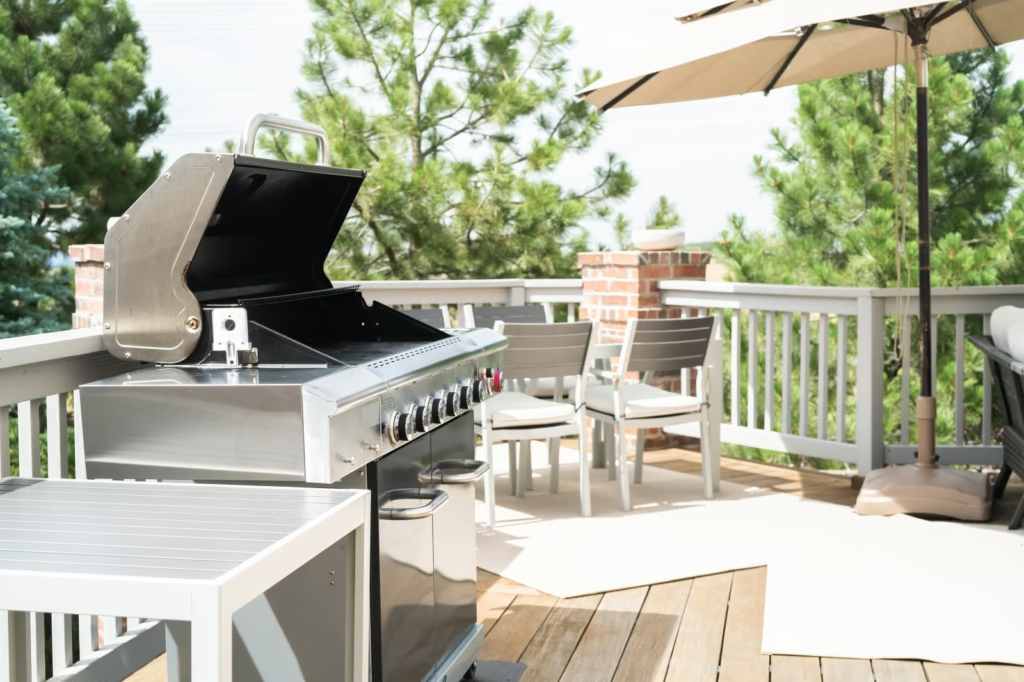
- Anchor the frame mechanically. An unfastened island is still a projectile
- Bolt down grills, refrigerators and cabinets to the concrete base
- Use stainless fasteners and rated connectors. Zinc-plated hardware bleeds rust in a season here
- Pergolas and covers need engineered anchoring and sealed drawings for the permit
Flood zones and the substantial improvement rule
Coastal Pinellas sits inside Special Flood Hazard Areas, and improvements there face extra review. The City of Safety Harbor requires SFHA structures to be reviewed for Substantial Improvement and Substantial Damage under the 49% rule before submittal to Pinellas County.
Two practical takeaways. Elevate the pad and slope drainage away from the house. And value the project honestly, because stacking an island onto other renovations at a flood-zone address can trip a substantial improvement review.
Should you DIY or hire a licensed contractor?
Reasonable to DIY: clearing and leveling, framing and cement board on a non-permitted freestanding island, veneer and tile, setting a prefab unit on an existing slab.
Hire a licensed pro: any gas line, new electrical circuits, water supply and drainage, anything with a roof or engineered anchoring, and anything requiring a permit or inspections.
DIY saves 20% to 40% of total cost. That saving disappears the first time a project fails inspection, or when an unpermitted island surfaces during a title search at resale.
Verify the contractor first
- Search them in the Pinellas County Construction Licensing Board database
- Confirm the license is active. Permits are not processed for inactive contractors
- Ask for the license number plus current liability and workers' comp certificates
- Confirm who pulls the permit. If they ask you to pull it as owner-builder, liability shifts to you
Our guide on what to check before hiring a general contractor covers the rest.
How do you protect an outdoor kitchen island during hurricane season?
The season runs June 1 to November 30. Tampa Bay learned in 2024, with Helene and then Milton, that a built outdoor space needs a shutdown routine.
- Shut off gas at the main valve; store portable propane away from the island
- Kill power to the outdoor circuit at the breaker
- Remove everything loose. Furniture, decor and covers become projectiles
- Secure or remove the grill hood if it is not a bolted-down built-in
- Fit storm covers over appliances and cabinet openings
- Clear drains so water moves away from the house
- Photograph everything for insurance
Afterward, check for water intrusion, mold and structural damage, and test utilities before use. Our hurricane preparation and recovery guide covers the whole property.
What a compliant Clearwater build looks like
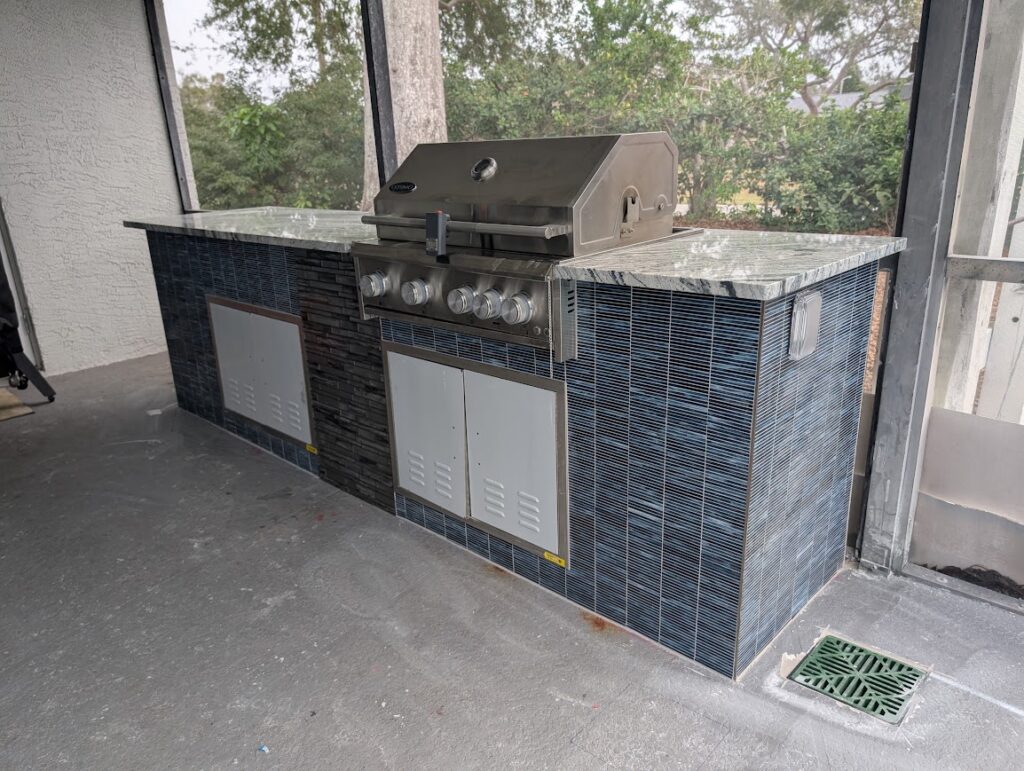
Scope: 8-foot L-shaped island on an existing lanai slab. Built-in gas grill, under-counter refrigerator, no sink. Steel stud frame, stone veneer, porcelain counter, 316 stainless doors.
| Stage | What happens | Who |
| 1. Jurisdiction check | Confirm city vs. county | Homeowner or builder |
| 2. Design and drawings | Layout, cut sheets, anchoring, utility routing | Builder |
| 3. Permit submittal | Application, survey, plans, subcontractor form | Builder |
| 4. NOC recorded | Required over $5,000, on site for inspections | Homeowner records |
| 5. Rough trades | Gas and electrical rough-in, then inspection | Licensed subs |
| 6. Structure | Steel framing anchored to slab, cement board | Builder |
| 7. Finish | Veneer, counter, 316 doors, appliance set | Builder |
| 8. Final inspection | Gas, electrical and building sign-off | Inspector |
Skipping stage 4 is what most self-managed projects get wrong. Skipping stage 1 is what makes stage 3 non-refundable.
One scheduling note: coastal communities across Pinellas are rebuilding and elevating to updated FEMA requirements, so the building department is running higher-than-normal permit volumes. If you are updating an existing setup rather than starting fresh, see our outdoor kitchen renovation work.
Ready to price your outdoor kitchen island?
We walk your yard, check your flood zone and jurisdiction, and give you a written scope with a real number. No obligation. One project manager stays on your build from permit to final inspection, and you get their direct line.
Call (727) 314-2191 or request a free estimate. We build outdoor kitchen islands across Clearwater, St. Petersburg, Dunedin, Palm Harbor, Safety Harbor, Largo, Tarpon Springs and Oldsmar.
Frequently Asked Questions
Do I need a permit for a BBQ island in Clearwater?
If it is freestanding on an existing slab with a portable propane tank and an existing outlet, generally no. Add a hard gas line, new electrical, plumbing or a roof and a permit is required. Clearwater homeowners file with the City of Clearwater, not Pinellas County, which only serves unincorporated areas, Belleair Beach, Belleair Shore, Indian Rocks Beach, Kenneth City, Safety Harbor and Oldsmar.
How much does a built-in grill island cost in Pinellas County?
HomeGuide puts a built-in BBQ grill island at $3,000 to $10,000 installed for grills up to three feet, including basic hookups to existing utilities. Add $500 to $2,000 for permit costs, plus trenching if the island sits away from existing gas, water and power.
Is 316 stainless worth the upcharge near the Gulf?
Within a mile of the Gulf or Intracoastal, yes. Grade 304 has no molybdenum and salt air alone pits it. Grade 316 has 2% molybdenum and resists chloride corrosion. Further inland, powder-coated 304 performs well. Manufacturers are clear that molybdenum slows corrosion rather than stopping it, so powder coat either way.
Can I build an outdoor kitchen island on a wood deck?
Not a good idea in Florida. Load capacity is a real constraint since masonry and appliances are heavy, and a wood deck is combustible next to a grill. A concrete pad is the better base for fire safety and wind anchoring, which is one reason we cover patio versus deck tradeoffs with clients before design.
How long does an outdoor kitchen island take to build?
Construction itself is usually one to three weeks. Permitting and inspections drive the timeline, not masonry. Plan review, trade inspections and final sign-off add weeks, and Pinellas is working through elevated permit volumes from coastal rebuilding. Schedule outside hurricane season where possible.
Does an outdoor kitchen island add resale value in Florida?
Industry estimates run 55% to 200% of project cost recouped at resale, highest in warm-climate states with year-round use, with one analysis putting Sun Belt ROI near 120%. Treat these as directional, not guaranteed. Built-in kitchens appraise higher than portable setups, and an unpermitted build works against you at closing.