Hurricane season runs June 1 through November 30. In Pinellas County, that is not a calendar note — it is a deadline. Helene and Milton combined damaged or destroyed more than 40,900 homes here in 2024 alone. The homeowners who fared best started preparing before the first storm was named.
This checklist covers every step: home hardening, insurance documentation, evacuation planning, flood zone rules, and what to do in the days before and after landfall. Work through it once before August, then keep it bookmarked for when the hurricane season gets active.
Key Takeaways
- About 78% of tropical storm activity in Florida happens between mid-August and mid-October — your prep window is now
- 40,910 Pinellas County homes were damaged or destroyed between Hurricanes Helene and Milton in 2024
- Impact windows on all openings qualify for the maximum wind-mitigation insurance credit under Florida Statute 627.0629, saving $1,000 to $3,500 per year depending on your premium
- Pinellas County evacuation zones run A through F, with Zone A being the most vulnerable and likely evacuated first — know yours before a storm is named
- The My Safe Florida Home grant covers up to $10,000 toward impact windows, impact doors, and hurricane shutters — but funding is first-come, first-served
Table of Contents
- Step 1 — Harden your home before hurricane season starts
- Step 2 — Know your flood zone and what it requires
- Step 3 — Review your insurance before June 1
- Step 4 — Document your home for insurance claims
- Step 5 — Build your supply kit
- Step 6 — Know your evacuation zone and plan your route before a storm is named
- Step 7 — What to do 72 hours before landfall
- Step 8 — After the storm passes
-
Frequently Asked Questions
- What is the most important thing Clearwater homeowners should do before hurricane season?
- Do impact windows eliminate the need for hurricane shutters in Clearwater?
- What is Pinellas County’s evacuation zone system and how do I find mine?
- Can I get a grant to install impact windows before this hurricane season?
- What should I do first after a hurricane damages my Clearwater home?
Step 1 — Harden your home before hurricane season starts
This is the step with the longest lead time, and the one most Clearwater homeowners skip until it is too late. Once a storm is in the Gulf, contractors disappear and supply prices spike. Doing home-hardening work off-season, between May and July, typically costs $1,500 to $8,000 — the same work done during a forecast can cost two to three times more, with high risk of running out of materials and contractor availability.
The four areas to address before the hurricane season peaks:
Windows and doors. Your openings are the first line of defense and the first point of failure in a hurricane season. When a standard window fails under wind load, pressure enters the home and the roof can separate from inside. Impact-rated windows and doors, or code-approved hurricane shutters, prevent envelope breach. In Pinellas County, all openings must meet current Florida Building Code 8th Edition standards for any new construction or significant renovation.
A licensed Clearwater contractor can assess your current openings and tell you which qualify for the My Safe Florida Home grant. Florida lawmakers reappropriated over $405 million to the My Safe Florida Home program in the Memorial Day 2026 state budget, aimed at clearing a backlog of roughly 45,000 homeowners with completed inspections. Funding is first-come, first-served. Apply at mysafeflhome.com before the hurricane season peaks.
To understand how impact windows are built and what makes them different from standard glazing, the hurricane window construction guide on the OCC site covers the laminated glass and frame engineering behind the product approval system.
Garage door. The garage door is the largest single opening on most homes and the most vulnerable point under high wind load. If yours is not rated for your county’s design wind speed, it can fail under pressure before your windows do. A wind-rated garage door brace kit runs $50 to $300 installed. A full wind-rated door replacement is the stronger option if your door is more than 15 years old.
Roof-to-wall connections. Hurricane straps, clips, and truss anchors tie your roof structure to your walls. Homes built before 2002 often lack them entirely. A Florida-licensed structural engineer can inspect your attic and tell you what connectors are present and whether they meet current Florida Building Code standards. Adding them does not require a full roof replacement.
Pool cages and screened enclosures. These provide zero hurricane season protection and become dangerous projectiles in high winds. Florida lanais are screened enclosures that provide zero hurricane season protection — during a storm, the screen tears away and the aluminum frame becomes airborne debris. Decide in advance whether to remove or brace the screen panels before a storm approaches.
Step 2 — Know your flood zone and what it requires
Most Clearwater homeowners think about wind when they think about hurricanes. Storm surge and flooding cause more property damage in Pinellas County than wind. Understanding your flood zone before the hurricane season starts changes how you prepare.
Pinellas County evacuation zones run A through F. Zone A is the most vulnerable and will be evacuated first. Flood zones, which determine FEMA’s insurance and building requirements, are separate from evacuation zones.
A large portion of coastal Pinellas falls inside FEMA-designated Special Flood Hazard Areas, classified as Zone AE or Zone VE. If your property is in one of these zones, two specific requirements apply that most homeowners are not aware of:
The 1-foot-above-crown-of-road rule. Certain flood zones in Pinellas County require that the finished floor of a structure be a minimum of 1 foot above the crown of the road — the highest point of the street in front of your home. This is not an estimate. It must be verified by a survey issued by a licensed Florida surveyor before any permitted renovation or new construction begins at that address.
The 50% Rule. If the cumulative value of improvements to a flood zone home reaches 49% of the home’s assessed value, the entire structure must be brought into full flood code compliance. A bathroom remodel stacked on top of post-storm repairs stacked on top of a room addition can push a coastal Pinellas property over that threshold without the homeowner realizing it.
Check your parcel’s flood zone status at msc.fema.gov before committing to any renovation scope. If you are in Zone AE or VE and planning any renovation this year, confirm your cumulative improvement history with the building department before pulling a permit. The OCC remote home renovation service covers how this flood zone coordination works for out-of-state owners managing Pinellas properties from a distance.
Step 3 — Review your insurance before June 1
Insurance is the most underprepared area in hurricane season readiness for Florida homeowners. Most people assume their policy covers storm damage. Many find out otherwise during the claim.
Understand your hurricane deductible. Florida wind deductibles are typically 2 to 5 percent of your home’s insured dwelling value — not a flat dollar amount. On a $400,000 home, that is $8,000 to $20,000 out of pocket before your insurer pays anything.
Flood insurance has a 30-day waiting period. Flood insurance typically has a 30-day waiting period — buy it before the hurricane season, not when a storm is forecast. Standard homeowner policies do not cover flood damage. A separate National Flood Insurance Program (NFIP) policy or private flood policy is required.
Wind mitigation inspection and discount. A major update to the OIR-B1-1802 wind mitigation form took effect April 1, 2026, changing which features qualify and how discounts are calculated under Florida Statute 627.0629. If your last wind mitigation inspection was before April 2026, or if you have made improvements since your last one, schedule a new inspection now and submit the updated form to your carrier. The discount does not apply automatically — your insurer needs the current form on file.
Impact windows on all openings qualify for the maximum opening-protection credit, the largest single discount category on the form. For Pinellas County homeowners with coastal premiums, that credit commonly runs $1,000 to $3,500 per year. If you installed impact windows or doors and never submitted an updated OIR-B1-1802, contact your insurer before your next renewal.
Confirm your policy is current. Once a storm is imminent, insurance carriers may restrict policy changes — you cannot bind new coverage or increase limits after a named storm enters the forecast. Review your dwelling coverage limit, personal property limit, additional living expense coverage, and flood policy limit before June 1. If you are underinsured on any of these, fix it now.
Step 4 — Document your home for insurance claims
A home inventory documented before a storm makes a claim faster and harder to dispute. Most homeowners who struggle with hurricane season insurance claims do so because they cannot prove what they owned or what their home looked like before the storm.
Do this once, update it annually in May:
- Walk through every room and record a video walkthrough on your phone. Open closets, cabinets, and storage areas. Narrate brand names, model numbers, and approximate ages of appliances and major items.
- Photograph all four exterior sides of your home, including roofline, soffits, fascia, gutters, windows, and doors.
- Photograph your electrical panel, HVAC unit, water heater, and any generator or backup power equipment.
- Keep physical copies of your insurance policies, deed, mortgage documents, vehicle titles, and identification in a waterproof container at home and a second set in a location outside the house.
- Store digital copies of all documents and photos in cloud storage accessible from any device.
A written inspection report with photos becomes part of your insurance documentation and gives you something concrete to compare against after the hurricane season’s first named storm passes through. The same logic applies to your home inventory.
If your home has had permitted improvements since your last claim or policy review — a new bathroom, new impact windows, a room addition — notify your insurer. Underreporting improvements leaves you without coverage to replace them at current cost.
Step 5 — Build your supply kit
Florida emergency management recommends keeping at least 7 days of supplies on hand, including food, water, medications, and batteries. For Pinellas County specifically, the barrier island and coastal geography means roads can close and power can stay out for extended periods after a major storm.
Water. One gallon per person per day, seven-day minimum. Fill bathtubs the night before landfall as a backup for flushing and hygiene.
Food. Non-perishable items that need no cooking: canned goods, protein bars, peanut butter, crackers, dried fruit. A manual can opener.
Power. A portable generator (under 10,000 running watts is Florida tax-exempt year-round in 2026), extra fuel in approved containers, battery-powered or hand-crank radio, power banks for phones, flashlights and spare batteries.
Medications. A 30-day supply minimum. If you rely on refrigerated medication, plan for extended power outages. A small portable cooler and ice supply buys time.
Documents and cash. Cash in small bills. ATMs and card readers go offline during extended power outages.
Pet supplies. If you have pets, confirm in advance which shelters are pet-friendly. Residents bringing pets to shelters must bring a carrier, supplies, a license, and immunization records.
Step 6 — Know your evacuation zone and plan your route before a storm is named
Knowing your evacuation zone is essential so you can make sheltering plans in advance of a hurricane season. The Pinellas County Know Your Zone tool allows you to enter your address to find your evacuation zone, the closest shelters, and hotel accommodations. Find your zone at pinellas.gov/evacuation-zone/ now, not when a watch is issued.
During Milton, Zones A, B, and C received mandatory evacuation orders. Shelters opened in Largo, St. Petersburg, Palm Harbor, Clearwater, and Dunedin. Pet-friendly shelters and special-needs shelters operate at separate locations from general population shelters — confirm which applies to your household before the hurricane season starts.
PSTA buses provide free transportation to shelters during a hurricane evacuation from designated pickup points in Clearwater and St. Petersburg. If you or someone in your household cannot drive, identify this option and the nearest pickup point now.
Plan two routes out of Pinellas County. US-19, I-275, and the Gandy Bridge are the main corridors, and all three become congested once evacuation orders are issued. A secondary route and a pre-selected destination — family outside the county, a hotel booked now with a flexible cancellation policy — gives you options when the main route is gridlocked.
If you own a Pinellas property remotely and are not in the area when a storm approaches, the OCC hurricane preparation and recovery guide covers what to coordinate from a distance, including contractor access, post-storm documentation, and emergency repairs.
Step 7 — What to do 72 hours before landfall
When a storm enters the 72-hour forecast cone for Pinellas County:
72 hours out:
- Confirm your supply kit is complete. Stores sell out of water, batteries, and generators quickly once a watch is issued.
- Fuel your vehicles. Gas stations run dry within hours of a warning.
- Deploy hurricane shutters or confirm impact windows are sealed and latches are secure.
- Move patio furniture, planters, grills, umbrellas, and any outdoor items inside or secured. Unsecured outdoor furniture becomes debris in 80 mph wind.
- Back up irreplaceable digital files to cloud storage.
- Contact your insurance carrier to confirm your policy is current and understand your deductible.
48 hours out:
- Fill bathtubs with water.
- Charge all devices, power banks, and battery backups.
- Confirm your evacuation route and destination if you are in Zones A, B, or C.
- Notify someone outside the storm zone of your plan.
24 hours out:
- If you are in an evacuation zone and authorities have issued an order: leave. Storm surge kills more people in Florida than wind. Do not wait for mandatory orders if you are in Zone A or B.
- Take your document container, medications, pets, and supply kit.
- Stay inside until officials confirm it is safe. The eye of a hurricane season brings a period of calm that can fool people into going outside before the back half of the storm arrives.
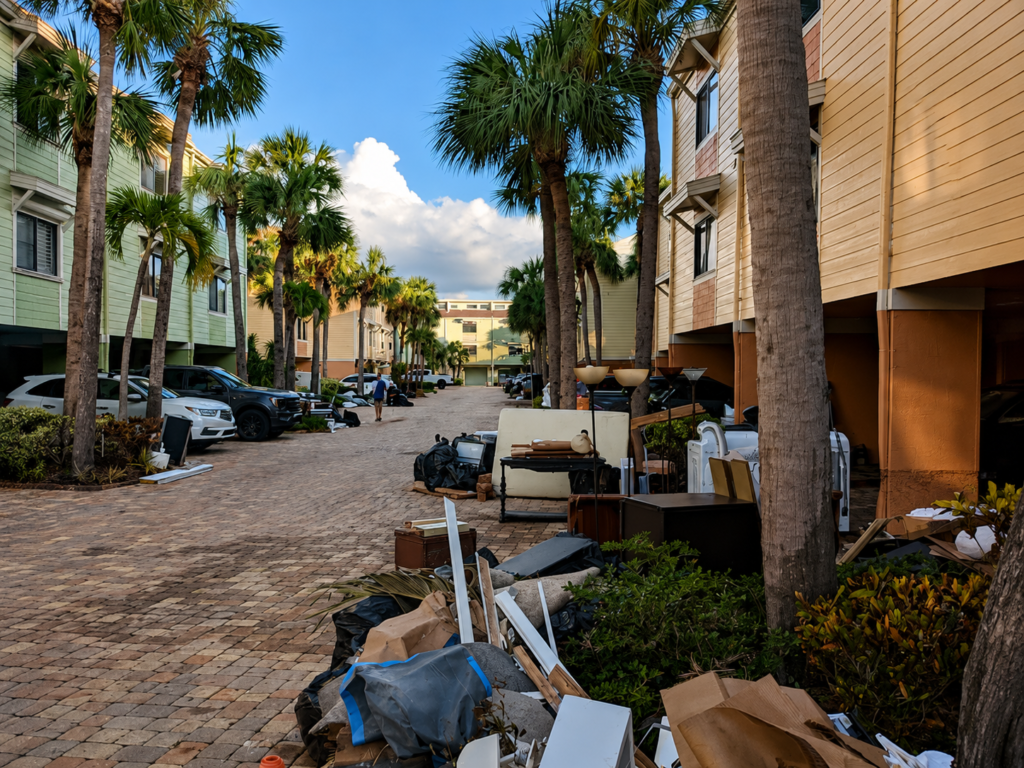
Step 8 — After the storm passes
Do not enter your home until authorities confirm it is safe to return. Downed power lines, compromised structures, and floodwaters are active hazards after a major storm.
When you do return:
Document damage before any cleanup. Photograph and video everything before moving a single piece of debris. Insurance adjusters need to see the damage as it was left by the storm. Cleaning up before documentation can complicate your claim.
Report damage to your insurer within 24 hours. Most Florida policies have a prompt-reporting requirement. Delays can give the carrier grounds to contest coverage. Call your insurer first, then a licensed contractor.
Watch for mold. Mold can begin growing within 24 to 48 hours after water intrusion. Any water inside the home — from roof damage, flooding, or broken windows — needs to be removed and dried immediately. The water removal guide for flooded Clearwater homes covers the extraction and drying process for Pinellas County properties.
Only hire licensed contractors for repairs. After a major storm, unlicensed contractors move through damaged neighborhoods quickly. Florida law requires a state license for any structural, electrical, plumbing, or HVAC repair. Our guide on what to look for in a general contractor walks through the specific checks that protect you after a storm.
Track your repair costs and permits. All storm repair work above the permit threshold requires a building permit. Unpermitted repairs create title problems at resale and may void your insurance coverage for future claims in the same area. A licensed general contractor pulls the permit in your name and manages the inspection process.
If you need help assessing structural damage, coordinating emergency repairs, or managing permits after a storm, call One Clearwater Construction at (727) 314-2191 or request a free estimate. We serve Clearwater, St. Petersburg, Dunedin, Palm Harbor, Safety Harbor, Largo, Tarpon Springs, and Oldsmar.
Frequently Asked Questions
What is the most important thing Clearwater homeowners should do before hurricane season?
Find your Pinellas County evacuation zone and review your wind and flood deductibles before June 1.
Do impact windows eliminate the need for hurricane shutters in Clearwater?
Yes — impact-rated windows meeting Florida Building Code standards satisfy the opening-protection requirement and require no action before a storm.
What is Pinellas County’s evacuation zone system and how do I find mine?
Pinellas uses zones A through F with Zone A evacuated first — find yours using your home address.
Can I get a grant to install impact windows before this hurricane season?
The My Safe Florida Home program offers up to $10,000 in matching grants for impact windows and doors — apply at mysafeflhome.com before starting any work.
What should I do first after a hurricane season damages my Clearwater home?
Document all damage with photos and video before touching anything, then report to your insurer within 24 hours and verify any contractor’s license before signing. For a full post-storm repair walkthrough, see the OCC hurricane repairs and renovation guide.