
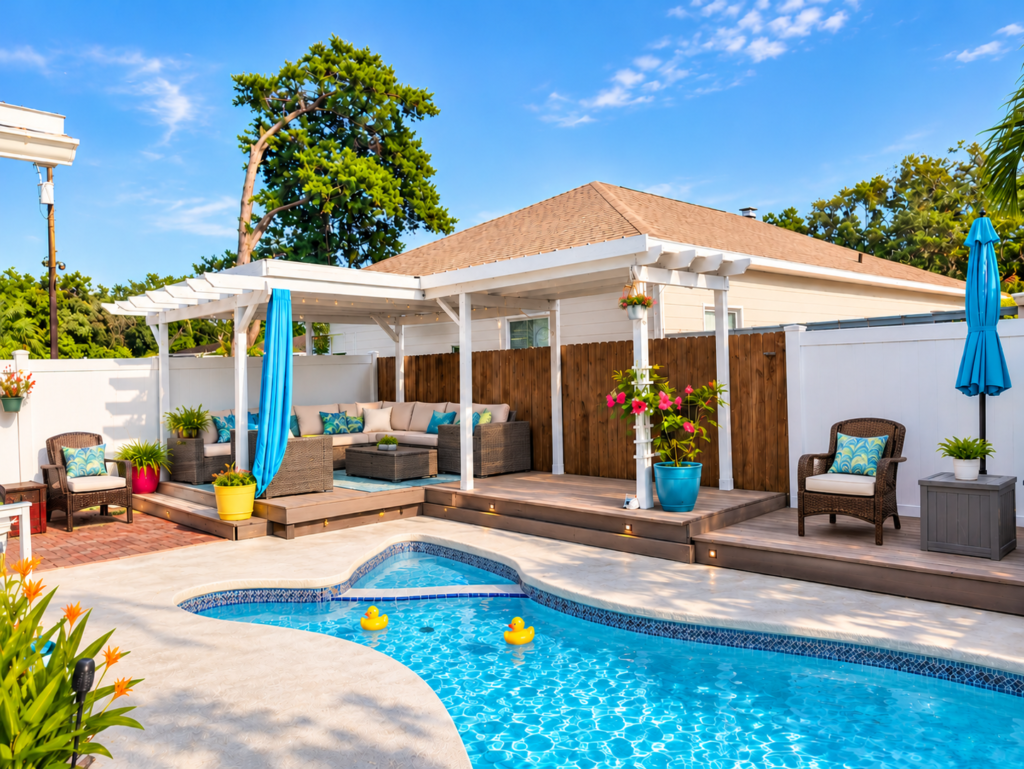
Key Takeaways
- A pergola in Clearwater starts at an estimated $5,000 for materials and the engineering to permit it.
- With labor and permits, most builds land between $10,000 and $15,000.
- The price moves with the type, the design, the materials, and whether it is attached or freestanding.
- Site conditions matter: footings for wind resistance, the soil, and nearby trees all factor in.
- Florida requires a pergola permit and structural engineering plans, so plan with a contractor before you buy anything.
A pergola in Clearwater starts at an estimated $5,000 for the materials and the engineering it takes to permit one. Add labor and permits, and most builds land between $10,000 and $15,000. From there, the type, the design, the materials, and your site set the final number.
The costly mistake is doing it backward. Plenty of homeowners buy a pergola kit first, then learn it cannot be permitted in Florida. The structure has to be engineered and permitted before it goes up, so planning comes before buying.
This guide covers what a pergola costs in Clearwater, the factors that move the price, the site conditions to plan for, and why a permit and structural plans are not optional here.
Pricing a project?
Free estimate from a licensed FL contractor. #CRC1334298
How Much Does a Pergola Cost in Clearwater?
The honest starting point is around $5,000. That covers the materials and the structural engineering needed to permit the build, which is the part a lot of homeowners do not plan for.
Once you add labor and the permit itself, most pergola projects land between $10,000 and $15,000. The table below lays it out.
| Pergola cost in Clearwater | Estimated |
| Materials and engineering (to permit) | Starts around $5,000 |
| Typical all-in, with labor and permits | $10,000 to $15,000 |
| Timeline | About 4 to 6 weeks after permit |
Those figures are a planning guide, not a quote. A pergola is priced by what it takes to build and permit on your lot, so the number moves with the choices and conditions below. A written estimate gives you the real figure for your yard.
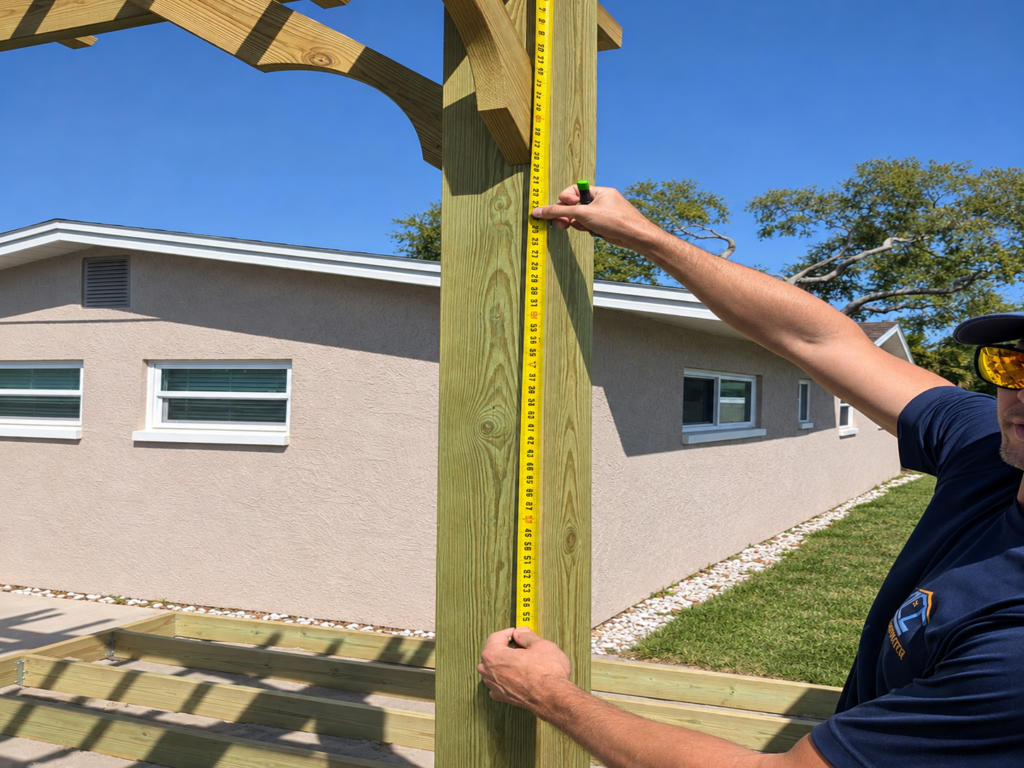
What Drives the Cost of a Pergola?
Several things decide where you land in that range. The biggest ones are the kind of pergola you want and how it is built.
Here is what moves a pergola’s price up or down:
- Type of pergola. An open-beam or slatted pergola sits lower, while a motorized louvered or fully roofed structure costs more.
- Design and sophistication. A simple shade frame is one thing; a detailed, finished structure with lighting is another.
- Materials. Aluminum and pressure-treated lumber price differently, and coastal-rated hardware adds to both.
- Attached or detached. Tying a pergola into the house is a different job than a freestanding one.
- Your site. Footings, soil, and nearby trees all affect the labor.
Those levers explain most of the gap between a $5,000 structure and a $15,000 one. One Clearwater Construction builds in aluminum or pressure-treated lumber, with powder-coated frames and marine-grade fasteners rated for direct coastal exposure, so the material choice is also a durability choice.
A Pergola Project in Clearwater
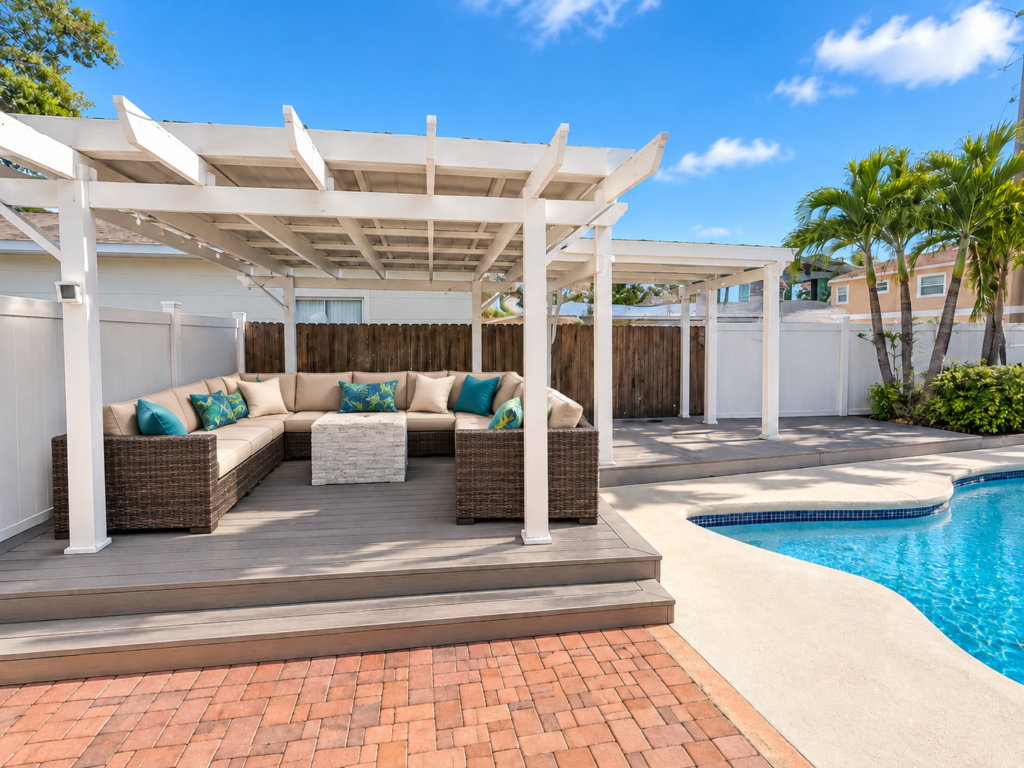
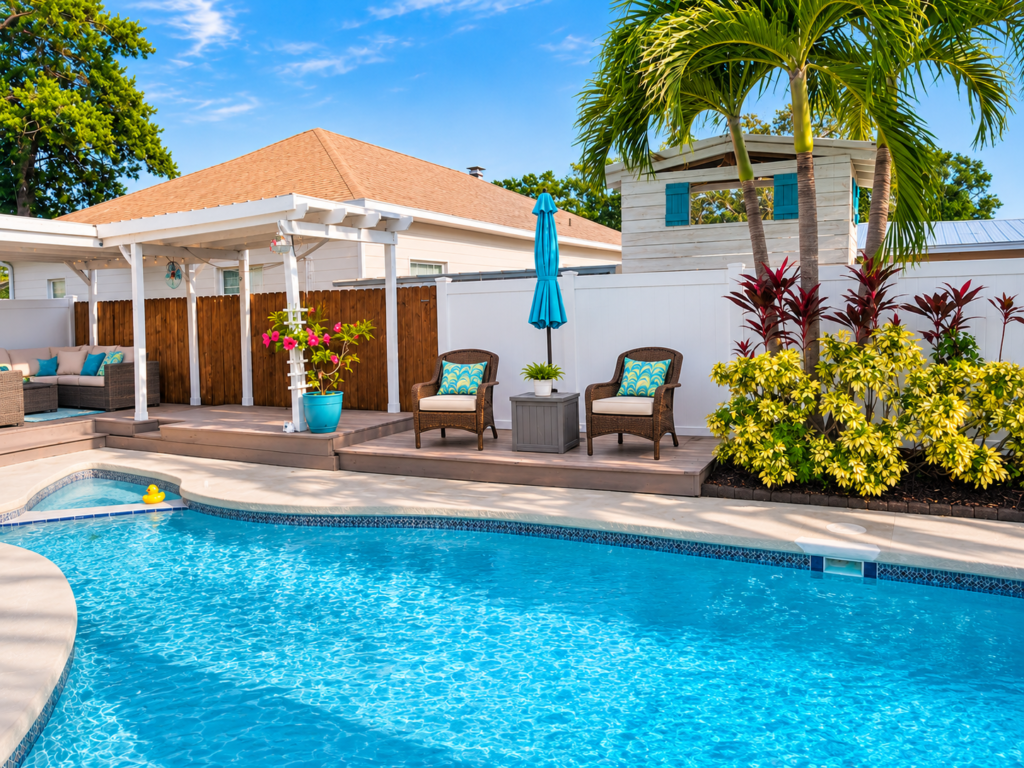
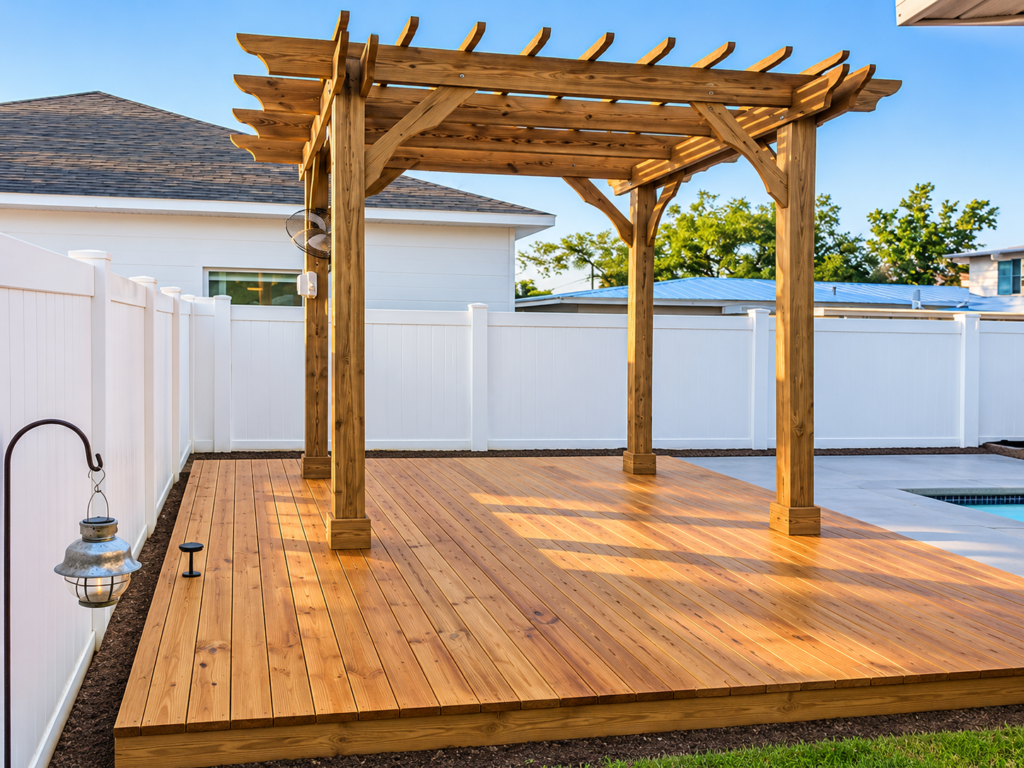
The numbers make more sense next to real work. One Clearwater Construction recently built an open-beam pergola in pressure-treated wood over a new deck beside a backyard pool, and it shows what a planned, permitted build actually looks like. Here is the structure itself, and how it came together with the deck.
Open-Beam Wood Over a Pool Deck
This is the open-beam style doing its job. Set over a new wood deck beside the pool, the pergola filters sun instead of blocking it, so the space stays bright and breezy.
A few things stand out in the finished build:
- An open-beam top that lets light through while framing the space.
- Arched corner brackets and shaped rafter tails, the detailing that lifts it above a plain frame.
- A freestanding footprint over the deck, anchored to stand up to Florida wind.
- A natural wood finish that can be sealed or painted white to match the yard.
Built and permitted the right way, it is the kind of project that lands inside the usual range instead of starting over.
Building the Pergola and Deck Together
Many pergolas go in over a deck rather than bare ground, and that pairing shapes the plan. Here, the deck and the pergola were built as one job.
Doing them together has real advantages:
- The posts and footings are set while the deck is still open, so nothing is retrofitted later.
- The deck layout and the pergola are sized to each other from the start.
- A freestanding design sits over the deck without tying into the house, which suits a poolside spot.
- The whole area is finished as one outdoor space instead of two separate projects.
Planning them together is also where a contractor earns the budget, since the footings have to be placed and anchored for wind before the deck boards go down.
The Site Conditions That Affect Your Pergola
Beyond the structure itself, your yard has a say in the price. In Florida, a pergola has to stand up to storm-season wind, and that starts in the ground.
A few site factors to plan for:
- Footings for wind resistance. Digging and setting proper footers is what anchors a pergola against wind uplift.
- The soil. What the footings are set into affects how they are dug and sized.
- Nearby trees. Roots and canopy can change where and how the structure goes in.
These are the kinds of details that get missed when a pergola is bought before it is planned. One Clearwater Construction engineers every pergola for Florida wind load requirements, so the footings and framing are built for the conditions, not just the look. Addressing them early is part of a smart outdoor living plan.
Why You Cannot Just Buy a Pergola Kit
This is the part that catches homeowners off guard, and it is worth spelling out. A pergola kit off a shelf is not automatically something you can legally install in Florida.
We recently had a homeowner come to us after buying a pergola kit from a big-box store for about $2,500. It came with no structural engineering plans and no wind or impact uplift rating, which meant it could not be installed under the Florida Building Code. The homeowner ended up returning it and starting over.
The reason is simple. Florida municipalities and counties require a pergola permit and structural engineering plans, both for liability and for safety. A kit that skips those cannot clear permitting, no matter how good the price looked.
The table below shows why the order matters.
| Buying a kit first | Planning with a contractor | |
| Structural engineering | Usually none included | Engineered for Florida wind load |
| Permit-ready | Often cannot be permitted | Designed to pass permitting |
| Outcome | May be unusable under code | Built to the Florida Building Code |
So the cheap kit is rarely the cheap option. When it cannot be permitted, you pay twice, once for the kit and again for the build you should have planned from the start.
Plan With a Contractor Before You Buy
The takeaway from that story is that the plan comes first. Decide the structure, the site, and the engineering with a contractor, then build, rather than buying a structure and hoping it fits the rules.
One Clearwater Construction handles the full path on a pergola, so none of it falls on you:
- Design and engineering. The structure is engineered for Florida wind load from the start.
- Permits. The company files every permit and schedules every inspection for Florida Building Code compliance.
- The build. Structural construction, plus gas and electrical where the design calls for it.
Because the permit and engineering are built into the process, you avoid the kit trap entirely. Most pergola builds run about 4 to 6 weeks after the permit is issued, and you never deal with the building department yourself. That is the communication-first way the team works, and it is the surest way to land inside the $10,000 to $15,000 range instead of starting over.
Ready to Price Your Pergola?
A pergola adds shade, value, and a reason to spend more time outside, and the right plan keeps the budget honest. We’ll design it, engineer it, and permit it, so it goes up once and stands up to storm season.
Request a free estimate, and we’ll map your pergola from footings to finish.
Frequently Asked Questions
How much does a pergola cost in Clearwater, FL?
A pergola starts around an estimated $5,000 for the materials and engineering to permit it, and most builds land between $10,000 and $15,000 once labor and permits are added. The final price depends on the type, design, materials, and your site. A free estimate gives you the exact number.
Do you need a permit for a pergola in Florida?
Yes. Florida municipalities and counties require a pergola permit and structural engineering plans, for both liability and safety. One Clearwater Construction files the permit and handles the inspections for you.
Can I install a pergola kit I bought myself?
Often not. Many kits come with no structural engineering plans and no wind or impact uplift rating, which means they cannot be permitted or installed under the Florida Building Code. It is why planning with a contractor before buying saves money.
What makes a pergola more expensive?
The type and the build. A motorized louvered or fully roofed pergola costs more than an open-beam or slatted one, and premium materials, a detailed design, and a site that needs extra footing work all push the price toward the top of the range.
How long does it take to build a pergola?
Most pergola builds run about 4 to 6 weeks after the permit is issued. The permitting and engineering come first, so the overall timeline depends on how quickly the design and permit move.