
Key Takeaways
- A curbless shower costs about the same as a standard shower, an estimated $12,000 to $15,000 for a 5×8.
- OCC usually recommends a small, low-profile curb rather than going fully curbless.
- The reason is water control: a flat entry needs a careful drain design and a fixed glass panel with gaskets.
- OCC does build fully curbless showers for genuine step-free access needs.
- Bathroom work runs about 2 to 3 weeks after the permit, which OCC pulls and inspects for you.
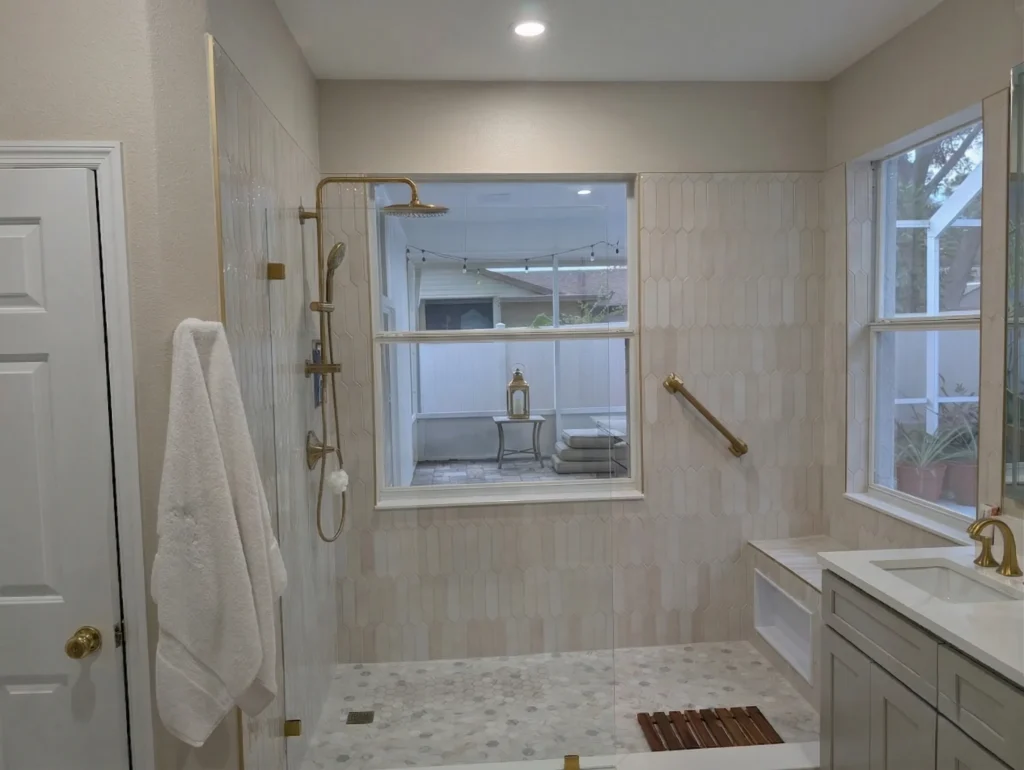
A curbless shower has little or no curb at the entry, and it costs about the same as a standard shower, roughly an estimated $12,000 to $15,000 for a 5×8. The honest part most guides skip is this: One Clearwater Construction usually recommends a small, low-profile curb instead, because it controls water far better.
The appeal of going curbless is easy to see. A flat entry looks modern, reads as open, and removes the step. The problem is water, because with little or nothing to hold it in, where the water goes has to be designed carefully or it ends up on your bathroom floor.
This guide covers what a curbless shower is, what it costs, why OCC leans toward a small curb, the water design a true curbless build needs, and when going fully curbless actually makes sense.
What Is a Curbless Shower?
A curbless shower, sometimes called a zero-threshold shower, drops the raised curb that a standard shower uses to hold water in. The floor stays level from the bathroom into the shower, with no step or lip to cross.
That flat entry is the whole draw. It is also the whole challenge, because the curb was doing a job, keeping water inside the shower.
Here is what sets a curbless shower apart from a standard one:
- No step or lip at the entry.
- A floor that reads as one continuous surface with the bathroom.
- Water managed by the floor slope, the drain, and the glass instead of a curb.
- An open look that can make a small bathroom feel larger.
So the difference is more than cosmetic. Taking the curb out changes how you enter the shower and how the water has to be handled, which is the part that decides whether the build holds up.
How Much Does a Curbless Shower Cost in Clearwater?
Going curbless does not cost much more than a normal shower. The curb itself is not a big-ticket item, so removing it is not where the money goes.
A standard 5×8 shower build runs an estimated $12,000 to $15,000, and a curbless version lands in about the same place. The table below sums it up.
| Curbless shower cost | Estimated |
| 5×8 shower build | $12,000 to $15,000 |
| Curbless vs a curbed shower | About the same price |
| Timeline after permit | 2 to 3 weeks |
What actually moves the number is the rest of the build, not the curb. A few things to weigh:
- The size of the shower and the bathroom around it.
- The tile you choose, from large-format to mosaic accents.
- Whether you add a frameless glass panel and built-in niches.
- Extras like a heated floor or grab bars set into the tile.
Because the curb is not the cost driver, the budget question is really a bathroom question. For the full picture, the walk-in shower cost breakdown lays it out, and a written estimate gives you the exact figure for your home.

Does OCC Recommend a Curbless Shower?
Here is the straight answer most sites will not give you: usually not. One Clearwater Construction generally recommends a small, low-profile curb rather than going fully curbless.
The reason is water. A curb, even a short one, does a lot of quiet work keeping water inside the shower. Take it away entirely, and the water has nowhere to be held, so it has to be managed by design alone. A small curb gives you nearly the same open, step-over-nothing feel with far more reliable water control.
The table below lines up the three options.
| Shower entry | Water control | OCC’s recommendation |
| Standard curb | Strongest containment | Traditional and reliable |
| Small / low-profile curb | Strong containment, nearly step-free | What OCC usually recommends |
| Fully curbless | Needs careful drainage and a fixed glass panel | Built for genuine step-free needs, not the default |
That does not mean curbless is off the table. It means it is a specific choice for a specific need, not the automatic best pick. Here is how to think about it:
- If you want the open look and an easy step-in, a small curb gets you most of the way with less risk.
- If you need true step-free access, for a wheelchair or walker, fully curbless is the right call.
- Either way, the water has to be designed for, which is the next section.
So the honest recommendation is to start with a small curb and go fully curbless only when a real accessibility need calls for it.
The Water Problem With Going Curbless
A curbless shower lives or dies on where the water goes. With little or no curb, the design has to do the containing, and that takes more than good intentions.
One Clearwater Construction is direct about the build quality underneath. On its Clearwater bathroom work, it says “waterproofing is where we don’t cut corners, proper shower-pan systems, sealed backer board,” and it installs “waterproofing systems built for Florida not products that fail after one summer.”
For a curbless or low-curb build, these pieces have to be right.
| Element | Why it matters |
| Fixed, non-moving glass panel with gaskets | Keeps splash in where there is little or no curb |
| Drain design and proper floor slope | Gives the water somewhere to go |
| Shower-pan system and sealed backer board | Waterproofing so nothing reaches the walls or subfloor |
| Slip-resistant flooring | Traction on a wet, flat floor |
A few of those deserve a plain-language note:
- A fixed glass panel that does not swing is better than a moving door here, because a gasketed, stationary panel holds water back more reliably.
- The drain and slope have to be planned so the floor carries water to it, not toward the bathroom.
- The waterproofing is carried through the whole shower, not just the pan, since there is no curb as a backup.
Get those right and a curbless shower works. Skip them, and it invites the exact water damage Florida homes already fight, which is the real reason OCC leans toward a small curb for most builds.
When Does a Curbless Shower Make Sense?
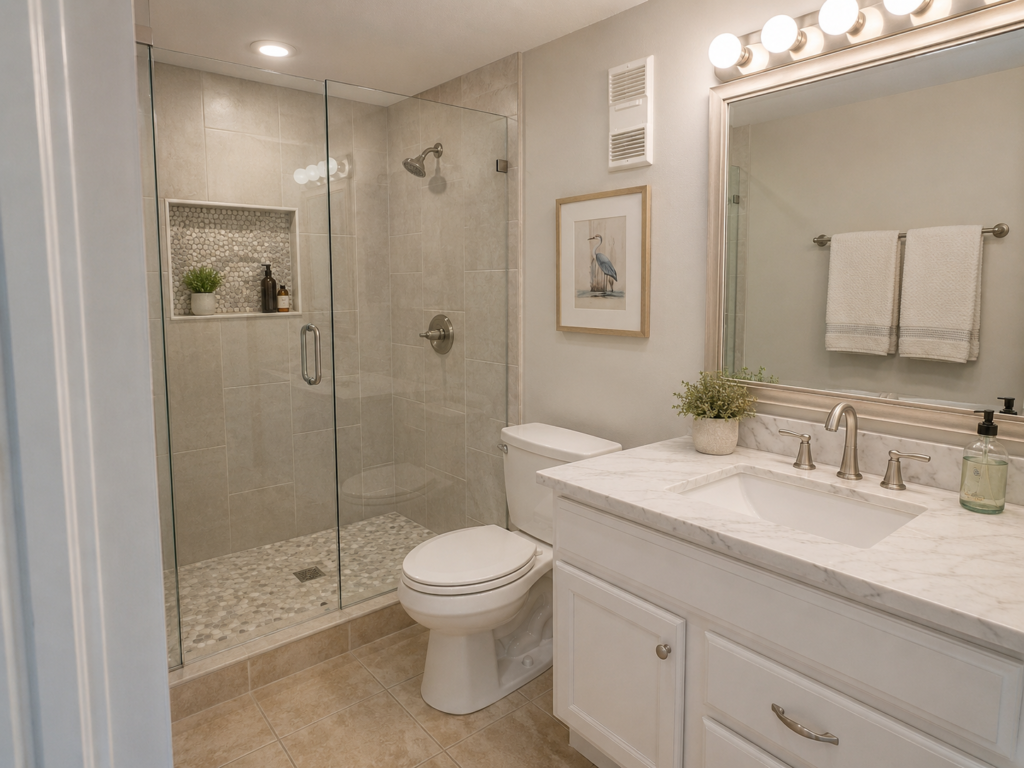
There is one case where fully curbless is clearly worth it: genuine step-free access. For a homeowner using a wheelchair or walker, a flat entry is not a style choice; it is what makes the shower usable.
One Clearwater Construction does this work. The team builds aging-in-place bathrooms in Safety Harbor with “curbless walk-in showers, grab bars integrated into the tile so they don’t look clinical, and slip-resistant flooring,” designed to be “comfortable now, and built to stay livable for years.”
For that need, the features that matter:
- Grab bars set into the tile for support that looks built-in, not medical.
- Slip-resistant flooring for traction on a wet, flat floor.
- A wide, open entry that a walker or wheelchair can clear.
- The full water design above, so the step-free floor still stays dry.
For everyone else, a low curb usually gives the look and the easy step-in without the added water risk. The right answer comes down to whether you need step-free access or just want the open feel.
Do You Need a Permit, and How Long Does It Take?
A curbless or low-curb shower is part of a bathroom remodel, and that work needs a permit. New plumbing and the waterproofing rebuild both fall under the building code, and the job gets inspected.
The timeline is shorter than most people expect. One Clearwater Construction lists bathroom work at about 2 to 3 weeks after the permit is issued. The company files the bathroom permit and handles the inspections, so you are not dealing with the county yourself. That is the communication-first way the team runs a job, keeping you updated at each step.
Curbless, Low Curb, or a Full Bathroom Remodel?
A shower rarely gets rebuilt on its own. If the curb question came up as part of a bigger project, it is worth seeing where it fits. A curbless or low-curb shower slots into a bathroom renovation alongside the tile, vanity, and fixtures, and many homeowners address it during a tub-to-shower conversion, turning a tub they never use into a walk-in shower with the entry they want.
Whichever way you go, the shower is built from the ground up, so the curb height and the water design are decided at the start, not patched in later.
Ready to Plan Your Shower?
A curbless shower can look great and work well, as long as the water is designed for. For most homes a small curb gets you there with less risk, and we’ll tell you straight which one fits yours.
Request a free estimate and we’ll map the design and cost before any work starts.

Frequently Asked Questions
How much does a curbless shower cost in Clearwater?
A curbless shower costs about the same as a standard shower, an estimated $12,000 to $15,000 for a 5×8 build. Removing the curb is not a cost driver, so the price is really set by the size, tile, and finishes. A written estimate gives you the exact number.
Does OCC recommend a curbless shower?
Usually not. One Clearwater Construction generally recommends a small, low-profile curb instead, because it controls water much better while still feeling nearly step-free. OCC does build fully curbless showers when there is a genuine step-free access need.
Do curbless showers leak or flood the bathroom?
They can if the water is not designed for it, which is the main risk of going fully curbless. It is managed with a proper drain design and floor slope, a fixed glass panel with gaskets, and full waterproofing. That added risk is why OCC often suggests a small curb.
What is a low-curb or small-curb shower?
It is a shower with a short, low-profile curb that still holds water in but is nearly step-free. It gives most of the open feel of a curbless shower with far more reliable water control, which is why it is OCC’s usual recommendation.
Is a curbless shower good for aging in place?
For genuine step-free access, yes. OCC builds curbless aging-in-place showers with grab bars set into the tile and slip-resistant flooring. For many homeowners, a low curb also works well, so the choice depends on whether true step-free access is needed.
How long does it take to build a curbless shower?
As part of a bathroom remodel, OCC estimates about 2 to 3 weeks after the permit is issued. The timeline depends on the size and scope of the work.